New Zealand PM Christopher Luxon calls national election for November 7
New Zealanders are set to go to the polls later this year amid a sluggish economy and rising unemployment.
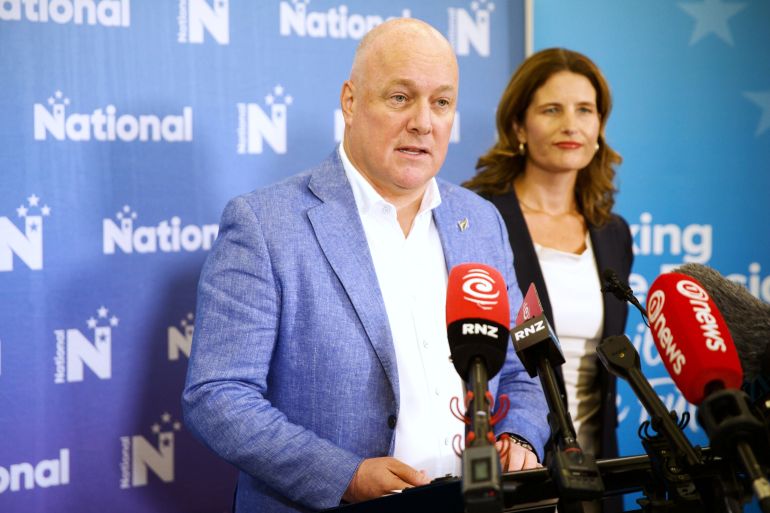

New Zealand will hold a national election on November 7, the country’s centre-right prime minister has said.
Christopher Luxon announced the election date on Wednesday as he touted his government’s record on the economy and crime.
Recommended Stories
list of 4 items- list 1 of 4Vinicius defies boos with star turn in Real Madrid’s 6-1 UCL rout of Monaco
- list 2 of 4US forces seize a seventh Venezuela-linked oil tanker
- list 3 of 4Russia-Ukraine war: List of key events, day 1,427
- list 4 of 4‘You’ll find out’: Trump speaks on Greenland’s fate and the future of NATO
Luxon said inflation had fallen from 7 percent to 3 percent and there were 38,000 fewer self-reported victims of crime on his government’s watch.
“When we took office, the country was going in the wrong direction, and it’s taken a lot of hard work in the last two years to start turning things around,” the prime minister said in a statement.
“Continuing to deliver on our plan to fix the basics and build the future so that Kiwis around the country get more results like these will remain our focus in the lead – up to the election later this year,” he added.
Luxon’s National Party formed a coalition with the populist New Zealand First and pro-business ACT parties after delivering a crushing defeat to the centre-left Labour Party at the 2023 election.
Luxon, a former chief executive of Air New Zealand, ran on a platform focused on law and order and cost-of-living issues in the wake of the COVID-19 pandemic.
But his government’s record has faced growing scrutiny amid sluggish economic conditions. New Zealand’s economy contracted during three out of the last six quarters that ended in September, and unemployment in November rose to 5.3 percent, the highest in nearly two decades.
Recent opinion polls have suggested the National Party is losing ground to Labour, led by Chris Hipkins, though his party would still retain power with the help of its coalition partners under the most recent projections.
New Zealand holds elections for its unicameral parliament every three years, but it is up to the government of the day to choose the exact date.
Coalition governments are the norm in New Zealand because of the country’s mixed-member proportional system, which replaced first-past-the-post voting in 1996.